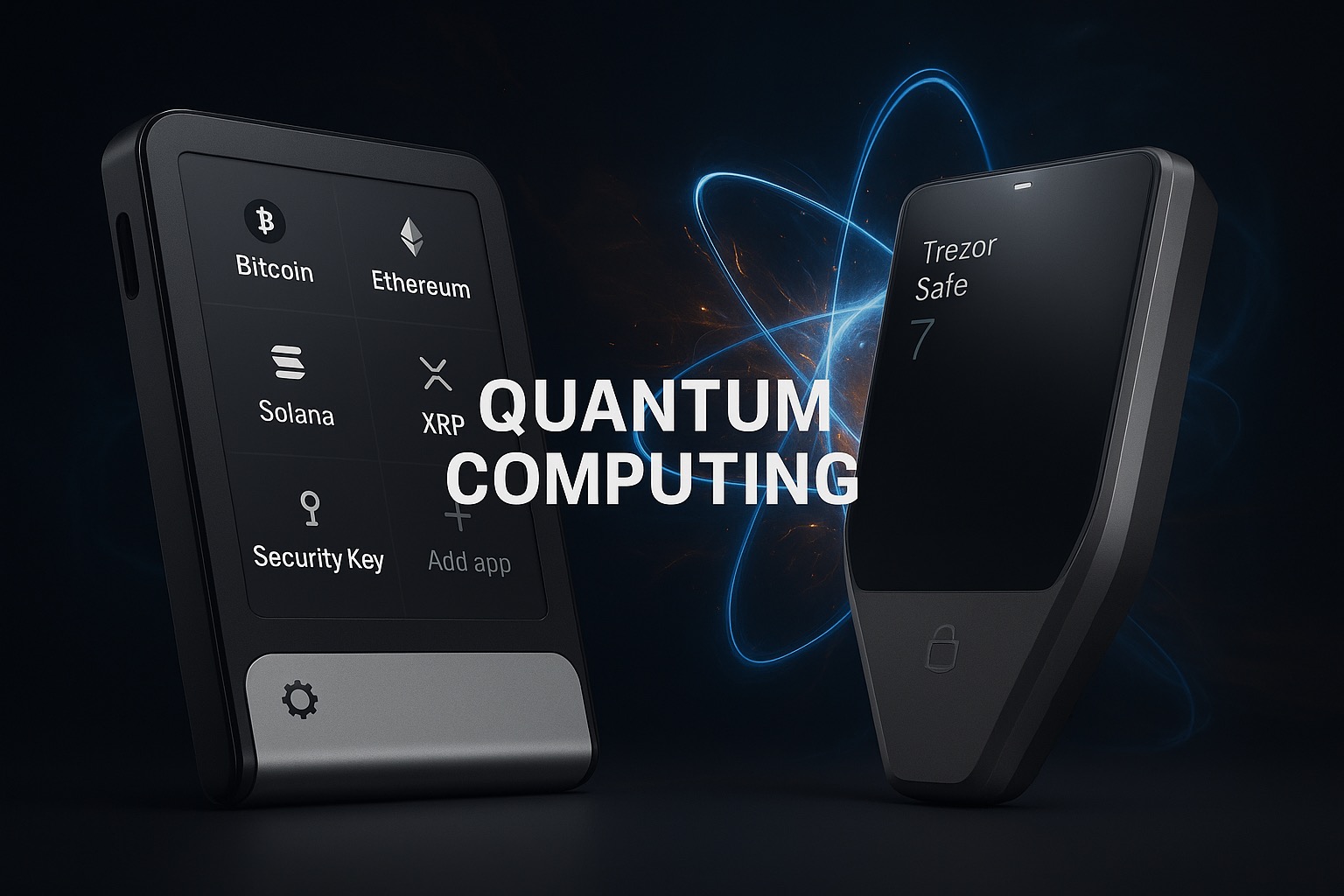
The modern blockchain ecosystem — from Bitcoin and Ethereum to Polygon and Solana — rests on a single, elegant cryptographic promise: public keys can be safely shared without revealing private keys. For decades, this mathematical asymmetry has powered everything from decentralized finance to NFT domains, smart contracts, and hardware wallets.
But quantum computing is changing that story. And it's not a theoretical concern anymore — it's a ticking clock.
The Cryptographic Foundation We Stand On
Every blockchain transaction, signature, and wallet today relies on asymmetric cryptography — algorithms such as:
- RSA (based on integer factorization) - ECDSA and Ed25519 (based on elliptic curve discrete logarithms)
These systems work because factoring large numbers or solving discrete log equations is _computationally infeasible_ for classical computers. That's what keeps your Bitcoin address, your Ethereum wallet, and even your Polygon NFT domain safe.
The principle is simple:
> It's easy to multiply two huge primes. It's nearly impossible to factor their product.
That asymmetry — the "one-way" property — is what public key cryptography thrives on. Until a quantum computer enters the chat.
Shor's Algorithm: The Quantum Game-Changer
In the mid-1990s, mathematician Peter Shor described a quantum algorithm that can efficiently factor large numbers and solve discrete logarithms. That's the exact mathematical Achilles' heel of RSA and ECC.
Here's what that means in practice:
- A large-scale, fault-tolerant quantum computer running Shor's Algorithm could derive your private key from your public key. - Once that happens, the encryption that secures the global financial system — not just blockchains — becomes transparent.
As MIT xPRO course notes put it:
> "RSA cryptography is based on the idea that it's easy to multiply two large primes, but very hard to factor them back. Quantum computing flips that assumption entirely."
So, in a post-quantum world, every exposed public key — every address that's ever been used on Bitcoin or Ethereum — could be reverse-engineered to extract its private key.
That's a catastrophic failure scenario for blockchain trust.
What Happens to Blockchains in the Quantum Era?
When a practical quantum computer with enough logical qubits becomes available, here's the chain of impact:
1. Immediate Vulnerability to Key Extraction
Once your public key appears on-chain (for example, when you make your first transaction), a quantum attacker could run Shor's algorithm to compute the corresponding private key. That would allow them to:
- Spend your crypto.
- Forge signatures.
- Impersonate nodes or validators.
2. Mass Exploitation via "Harvest Now, Decrypt Later"
Attackers are already collecting encrypted and signed data today, expecting to decrypt or forge it once quantum hardware matures. That includes smart contracts, digital identities, and private ledgers.
3. Blockchain Forks and Protocol Upgrades
Blockchains will need to hard-fork to adopt post-quantum cryptographic (PQC) algorithms such as:
- CRYSTALS-Kyber (for key exchange) - CRYSTALS-Dilithium, Falcon, or SPHINCS+ (for signatures)
The challenge: migrating billions of existing keys and contracts safely without breaking consensus.
The Role of Hardware Wallets in a Quantum Future
Hardware wallets remain the first line of defense for crypto users. They physically isolate private keys and handle signing within a secure enclave. However, they _cannot protect you from mathematical obsolescence_. If the signing algorithm itself (like ECDSA) becomes breakable, isolation no longer matters.
That's why "quantum-ready" hardware design matters — not just physical security.
The New Generation of Quantum-Ready Wallets (2025 Landscape)
Here's what current research and vendor roadmaps show:
| Wallet | Quantum-Readiness | Core Features | Market Status |
|---|---|---|---|
| Trezor Safe 7 | ✅ Updatable bootloader & dual-chip PQ architecture; firmware supports future Dilithium/Kyber/Falcon | PQ-ready signatures, wireless charging, full auditability | Flagship, shipping now |
| Ledger Nano Gen5 | ⚙️ PQ roadmap disclosed; firmware upgrades planned | Secure Element, active PQ research, frequent updates | New release, PQ update pending |
| Ledger Flex | ⚙️ Strong ecosystem, hybrid signature plans | Secure Element, Bluetooth connectivity | Shipping Q4 2025 |
| NGRAVE ZERO | ❌ No PQ bootloader yet | Physical resilience, air-gapped design | Available; classical-only |
| Trezor Model T | ❌ Legacy, ECDSA only | Open source, robust but not PQ-ready | Supported; classical |
Takeaway:
> The only wallet shipping today that's technically _quantum-ready_ is Trezor Safe 7 — its dual-chip architecture and updatable bootloader can accept post-quantum firmware once standards are finalized.
Ledger's newer models (Flex, Nano Gen5) are still classical but have active PQ development tracks. They'll likely enable hybrid (ECDSA + Dilithium) firmware signing within 1–2 years as standards like NIST's PQC suite stabilize.
What Makes a Hardware Wallet Truly Quantum-Safe?
A real quantum-safe wallet must:
1. Use PQ cryptography for firmware signing, key exchange, and transaction signing
- Dilithium, Falcon, or SPHINCS+ for signatures
- Kyber for pairing and backups
2. Reject legacy RSA/ECDSA firmware
- The bootloader must verify PQ or hybrid signatures and prevent rollback to classical firmware.
3. Support asset migration to PQ addresses
- The firmware must allow rotating existing keys to new, quantum-resistant ones once the blockchain protocol supports them.
4. Offer transparent audits and reproducible builds
- Open-source PQ firmware and published audits ensure vendor claims are verifiable.
5. Use AES-256, SHA-3, and Argon2id
- Symmetric primitives should already be quantum-resilient (Grover's algorithm only halves their effective key strength).
Realistic Timeline & What You Should Do Now
2025–2027: The Transition Phase
- Blockchain protocols begin integrating PQC schemes.
- Wallet vendors push hybrid firmware (ECDSA + PQ signatures).
- Users start migrating funds to PQ-compatible addresses.
2028–2030: Quantum Reality
- Early quantum computers capable of attacking RSA-1024/ECC-160 emerge.
- Legacy wallets and chains become unsafe.
- PQ-only signatures and hybrid chains dominate.
What You Can Do Today
1. Choose wallets with a PQ roadmap (Trezor Safe 7, Ledger Flex/Nano Gen5).
2. Avoid address reuse – each exposure reveals your public key.
3. Encrypt backups using AES-256 + Argon2id (no RSA wrappers).
4. Track vendor firmware releases and migrate early once PQ firmware is available.
5. Stay updated on blockchain PQC forks – e.g., Bitcoin's possible Dilithium-based Taproot successor, or Ethereum's PQ handshake proposals.
The Big Picture
Quantum computing isn't just another tech upgrade; it's a paradigm shift. When Shor's algorithm becomes practical, the mathematical backbone of digital security collapses. But it's not a death sentence for blockchain — it's an evolution.
Projects like NIST's PQC standardization, Trezor's Safe 7, and Ledger's hybrid cryptography efforts are paving the path forward. Those who prepare — migrating to PQ-capable wallets, updating firmware, and monitoring blockchain upgrades — will ride the transition smoothly. Those who ignore it risk watching their "immutable" assets vanish in a single quantum calculation.
Final Thought
The quantum age won't wait for blockchains to adapt — so our wallets, protocols, and habits must evolve first. In this new era, security is not just physical or digital — it's mathematical, adaptable, and forward-compatible.
Because in the end, the safest key is the one that's ready for tomorrow's physics.
Sources
MIT xPRO Quantum Computing Fundamentals - MIT's professional education program covering the fundamentals of quantum computing, including Shor's Algorithm and post-quantum cryptography implications for modern security systems.
NIST Post-Quantum Cryptography Standardization - The National Institute of Standards and Technology's comprehensive project to standardize quantum-resistant cryptographic algorithms, including CRYSTALS-Kyber, CRYSTALS-Dilithium, Falcon, and SPHINCS+.
Connect with Us
See this post on our LinkedIn - Join the conversation on quantum computing's impact on blockchain security and the future of cryptographic systems.
Follow us for more insights on quantum computing, blockchain security, and emerging cryptographic technologies!